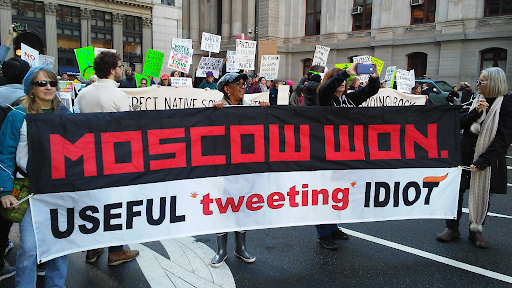
American protestors demonstrating in January, 2017, carrying a sign insinuating that Trump’s electoral victory was because of Russian influence on social media. Photo courtesy of flickr.
You probably use the internet every day, and statistically, you likely use it to get your news. In particular, over half of Americans read news on social media every single day. But, unfortunately, social media has turned into a digital battlefield where information is the weapon of choice. Especially since the highly contested 2016 presidential election, information warfare techniques deployed by highly trained professionals using state-of-the-art techniques have become more common, with the express purpose of wearing down your brain and making you crazy. This new information dynamic poses an existential problem to democracy in the United States.
Over half of all online traffic is conducted by bots (proponents of the “Dead Internet” theory are nodding along), and this only increases during election cycles. This takes the form of everything from innocuous status updates to highly detailed short-form content viewed by millions. In military terms, these are called psychological operations, and they are conducted on all social media platforms with the explicit purpose of funneling propaganda into the “discourse.” Next time you scroll through your feed on Instagram, TikTok, or Facebook, just remember that at least half of what you see is designed to confuse you, erode your trust, and disconnect you from a consensus reality.
“Knowledge resides in consensus, rather than in any transcendent or objective relationship between a knower and that which is to be known,” wrote sociologist Anthony Giddens, revealing a human vulnerability. Because we rely on others to determine truth, we are vulnerable to manipulation by concerted actors. J.M. Berger of The Atlantic explains it this way: “Objective reality is presumed to exist... But objective reality is apprehended through consensus. We do not set out, individually, to count the dead [from COVID]. We trust others to do it for us. When our enveloping social consensus agrees that 200,000 Americans have died, it becomes a fact. It becomes real.”
This reliance on consensus leaves you open to propaganda, and you are not immune to propaganda. It doesn't really matter if you have a smart phone or use social media apps. Enough of your contemporaries do that you are incapable of escaping the information they consume and spread. You fall victim to the same ideas that they did, whether you like it or not.
Organized and state-led digital campaigns steer your social media algorithms more effectively than individual influencers or users can even aspire to. Russia specifically spends millions of dollars on targeting specific demographics of users (like those already skeptical of vaccines), using easily accessible personal information through shell advertising companies, to steer key segments of the electorate. This strategy leverages so much of the modern information infrastructure we ignore to actively harm our consensus reality.
Often, these campaigns have been used in coordination with domestic actors who are less interested in the truth. Right-wing organizations like the Heritage Foundation, behind the infamous Project 2025, intentionally label information security operations as “partisan.” There is a pattern of collaboration between corporations who use high-volumes of traffic to profit from advertising sales and information collection, which is then purchased by foreign governments with anti-American views who use this information to smuggle in their destabilizing digital psychological warfare campaigns. This allows right-wing organizations more committed to power in government than political stability or legitimacy to create a vicious vortex online, often working in tandem with foreign governments.
The internet is not a neutral actor and has transformed into a highly politicized staging ground for lies and falsehoods. Right now, the Trump administration is working to intensify this process. But part of the flexibility in undermining our informational infrastructure comes from how socially we undervalue its significance. Ezra Klein, reporter for the New York Times, understands the role of information in a burgeoning "attention economy," where "attention [turns] into capital, because money follows it." Information needs to be understood as a commodity that can be controlled and priced.
In a perfect world, information would need more filters. Maybe not as restrictive as the Great Firewall, as it exists in China, or Russia’s draconian attempt at establishing “digital sovereignty” by controlling the social media of all its citizens, but rather something more controlled, regulated, and protected. The European Union (EU) stands as an exemplary model from which we in the US can learn a lesson. Through a multipronged approach of challenging misinformation through official channels, investigating the sources of misinformation, and holding companies accountable when misinformation is left unchecked to spread on their platforms, the EU is protecting its democracy.
It’s time to recognize information’s true value as an asset capable of reshaping reality. If we don’t learn how to control information, then we will continue to let it control us and repeat the mistakes of underestimating the outsized impact misinformation can have.
Jay Jacobson (GS ’28) is a Policy 360 staff writer comfortably at home in New York City, majoring in Political Science and Slavic Studies. They can be reached at jj3566@columbia.edu.